
Mastering Post-Deal Integration with Mark Sims
May 13, 2026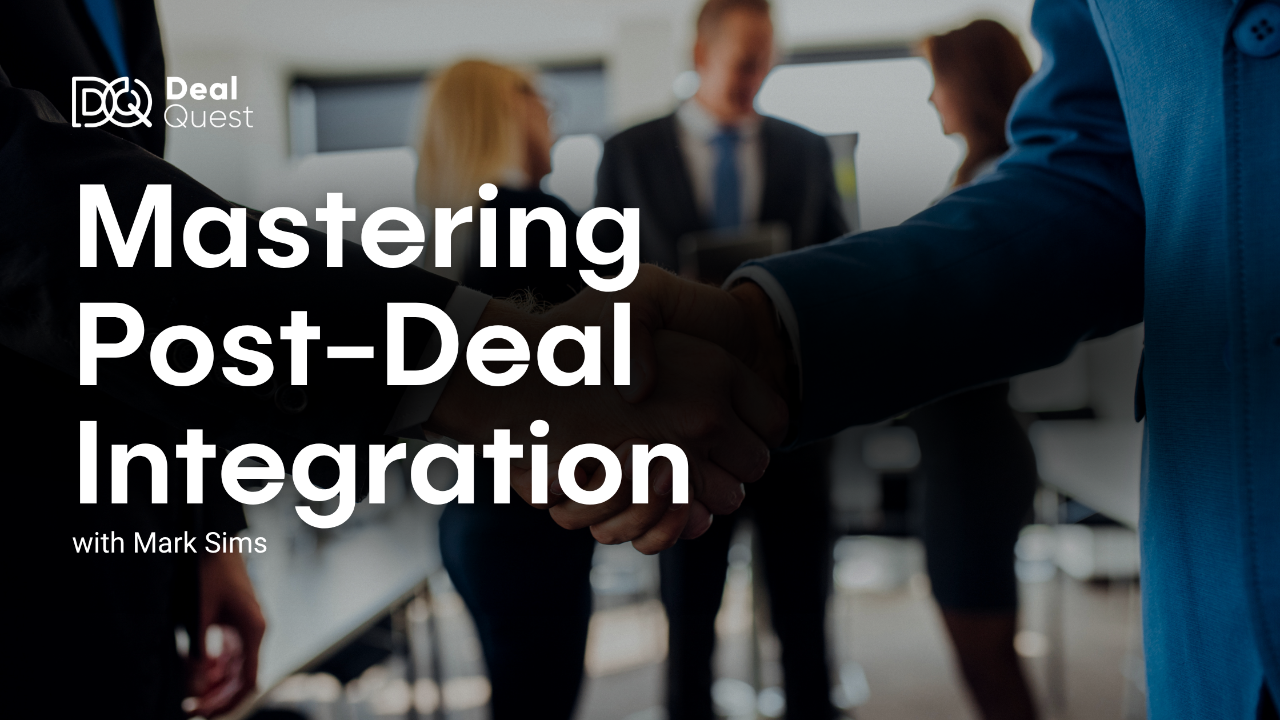
A friend of Mark Sims was deep in the sale of his business and finally feeling that exhale moment. The due diligence was wrapped, the documents were signed, the transaction was closing. Mark told him the same thing he tells everyone in that position. That is when the real work starts. The buyer now has to integrate what they just bought, and that is where the heavy lift actually happens.
I sat down with Mark Sims, managing principal of technology solutions at Consult MSG, to dig into a side of dealmaking that I have spent decades watching get shortchanged. Mark applies 25 years of experience in strategy, M&A, and information technology to lead transformation and growth initiatives for clients. He has a demonstrated track record in leading ERP implementations, optimizing existing systems to drive business insights through analytics, driving technology transformations across complex environments, and managing complex M&A transactions. Mark has held roles as CEO, Head of Strategy, and CIO across multiple industries including Consumer Products, Retail, Specialty Packaging, Manufacturing, and Private Equity. He holds a bachelor's in Industrial Engineering from the University of Michigan, a master's in Industrial Engineering from Cleveland State University, and completed the Advanced Management Program at The Wharton School.
Whether you are running a founder-led business considering a PE investment, sitting on a corporate development team trying to digest the last five acquisitions, or working in middle market M&A advisory, this conversation lays out the mistakes that consistently sink deals after close and the practical moves that prevent them.
From Architect Dreams to Deal Integration
When I asked Mark what he wanted to be as a kid, he gave me an answer I appreciated. He wanted to be an architect, and he made a point of telling me that was not a Seinfeld reference. He eventually got into engineering instead, partly because the schooling required for architecture felt daunting. He went on to earn his bachelor's and master's in Industrial Engineering, but the impulse to design and build things stayed with him.
That instinct shows up in his consulting work. Whether he is mapping a technology system, redesigning a process, or building an integration plan, the work scratches the same itch as the architecture career he never pursued. After 35 plus years of doing deals, I have noticed that the people who do integration well almost always have a builder's mindset. They see the whole structure before they start moving pieces.
The First Deal That Set the Tone
Mark's first real deal experience came when he was around 24 years old, working for a small AT&T division headquartered out of the UK that sold simulation software. The product handled factory simulations, modeling things like what happens to throughput if you speed up a line or add a machine. The division was sold to a UK based private equity firm, and Mark got a front row seat to how a PE acquisition actually plays out from the inside.
The headquarters had been in Cleveland, where Mark was based. After a search process, the new owners moved the headquarters to Houston, which happened to be where the new CEO lived. As Mark put it, "It's amazing how that usually works out." That kind of decision making is something I have seen over and over in my own deal practice. The official rationale lines up with the personal preferences of whoever has the authority. Anyone going into a PE transaction should expect this dynamic and plan for it.
Why PE Gets a Bad Reputation It Often Doesn't Deserve
I was on a panel recently at the RIA Edge conference where the topic was alternatives to PE investment in wealth management. Whenever there is a trend, there is always a backlash, and PE has been catching plenty of backlash lately. Some people treat PE as the only way to accelerate growth. Others treat it as something to avoid at all costs.
My take is simpler. PE is what it is. There are good firms and bad ones, just like every profession. When founders get upset with PE, it is almost always because of a disconnect between expectations and the actual model. PE invests for accelerated growth on a defined timeline. If you understand that going in, you can decide whether the trade-offs make sense for your situation.
Mark's perspective from the inside lined up with mine. He spent about 80 percent of his career working with publicly traded companies before moving into the PE space three years ago, and he came in expecting to find the heavy-handed behavior people complain about. What he actually found surprised him. He has seen real deference from PE owners toward management teams, with a willingness to let things play out as long as the business is performing. As Mark observed about both public and PE-backed companies, everyone has a boss. The question is whether you are aligned with where that boss wants you to be going.
The Founder Who Wakes Up With a Boss
I was on the phone with a client just before this conversation, working on a PE investment deal where we represent the company side. There are great reasons for them to do it, and I expect it will work out well. But I had to be direct with them. After this closes, you are no longer the king or queen of your business. Big decisions will need approval. There will be metrics and expectations. They already had a future acquisition in mind, and they are going to need PE approval to do it.
Mark sees the same pattern from the buy side. When he was doing corporate M&A at Scotts Miracle-Gro, a $4 billion company with the bureaucracy that comes with that scale, they would tell founders considering a sale, "You're not going to want to work here." Founders thought they wanted to stay involved, but the reality of having a boss after 30 years of running their own roofing company or plumbing business often hits hard. They have monetized their investment, they no longer have the same authority, and someone else is now focused on revenue or operations or strategy. When founders leave a portfolio company, the question of whether they were pushed out or chose to leave is often more nuanced than the headlines suggest.
The flip side that Mark made well is that the boss relationship cuts the other way too. Founders often feel isolated because they have built their business without a real sounding board. A good PE board, staffed with smart operators across multiple disciplines, can fill that gap. The portfolio also brings access to HR, IT, and financial expertise that a small or middle market company would never have on its own.
Why Integration Planning Starts in Due Diligence
Mark's central point on integration is one I have been making to clients for years. Integration thinking has to start during diligence, not after close. Most acquisition models bake in revenue or cost synergies. The only way to actually capture those is to hit the ground running on day one.
A lot of acquirers fall into the "first do no harm" trap, where they pause for six months after close so they do not upset anything. Mark sees that as wasted time, particularly in PE where investment horizons are limited. The high level integration strategy needs to be defined in diligence. What gets integrated. What does not. Channels, operations, facilities, systems. By the time the deal closes, ideally you have moved into specific integration planning, with a real execution plan ready to go.
This connects to something I see constantly on the legal side. Lawyers handle the documents, the financial folks handle the QofE, and we all advise on cultural and tech due diligence. Once the deal closes, we move on to the next transaction. The integration work happens after we leave, and that is where most deals actually succeed or fail. The percentage of deals that fall apart for integration reasons rather than economic ones is much higher than people realize.
The Cost of Indecision After Close
The firms that integrate well share a pattern. They have a plan, they execute decisively, and they move quickly. The people who need to leave know early. The people who need to stay get clarity on their roles, often with retention bonuses. That decisiveness pays off in two ways. You get to choose who leaves rather than losing the people you wanted to keep, and you avoid the months of distraction that come with uncertainty.
Mark added a layer to this around culture integration. Sometimes you are bringing together two firms with very different cultures. One was built around an empowered organization where leaders pushed decisions down. The other ran every decision through a single founder. If you wait six months and let everyone keep operating on their own, you miss the opportunity to build whatever culture you actually want. The us versus them dynamic that often shows up in failed integrations sticks around because nobody did the work to integrate culturally, operationally, financially, or systemically.
This conversation reminded me of Episode 337 with Jonathan Gardner, who made a point I think about often. The average return on all M&A across all industries across all time is essentially zero. Why do people still do deals? Some of it is ego. But the real failure points are culture and IT systems. Mark and Jonathan are saying the same thing from different angles. The deal economics matter, but execution after close is where value actually shows up or disappears.
The Integration Factory at Scotts Miracle-Gro
One of the most useful examples Mark shared came from Scotts Miracle-Gro. The company's ability to buy businesses far outpaced its ability to integrate them from a systems perspective. Acquisitions kept piling up. The integration backlog grew. Eventually they stood up something they called the Integration Factory, a dedicated team whose entire job was to snap smaller businesses into the mothership.
Mark joked that the team got mad at him whenever he said snap them in, because the work involved was anything but simple. But the principle behind the Integration Factory matters. If your acquisition pace exceeds your integration capacity, you have to either slow the acquisition pace or build dedicated integration capacity. Otherwise you end up with what Mark sees in his diligence work all the time, where an acquirer has done five deals that have not been digested yet, or in some cases ten or eleven small businesses that have all been acquired and are still operating completely independently. Trying to integrate the next acquisition into a structure that does not really exist creates problems that compound.
I had a client years ago who would call me every six months or so and say, "Corey, the cart's in front of the horse again. I need you to help me get the horse back in front of the cart." We did five or six deals for them in less than two years. Then he called and said they were taking a pause because they had 15 areas where the cart was still in front of the horse. They could not do another deal until they got their integration caught up. That kind of self-awareness is rare and worth its weight in gold.
People, Money, and Systems
Consult MSG is built around what Mark calls the three big problem areas in any transaction. People. Money. Systems. The firm started in transaction advisory work on the QofE and financial due diligence side, then expanded to add an HR and human capital practice and Mark's IT and technology solutions group. The way Mark frames the work, they help clients transact, transition, and transform.
The transition piece deserves attention because it is where I see a lot of deals struggle. Through diligence, you often identify that the current CFO or finance leader will not be able to provide the new PE owner with the level of detail and reporting they need. Consult MSG will sometimes step into interim management roles to figure out what is actually needed before recruiting a permanent replacement. The transform piece is where they help build out the capabilities the PE firm wants the company to have, whether that is a new ERP implementation or post-close integration projects identified during diligence.
The reason all three practices work together is that the diligence work generates a roadmap of what should happen after close. Sometimes the same firm that built the roadmap is the right one to execute it, particularly when transformational projects are involved. Mark gave the example of a client they did diligence on a year ago, where nothing happened post-close, and who recently re-engaged them to finally execute on a new ERP implementation. That kind of long-term advisory relationship is exactly what middle market PE needs.
From Middle Market to Public Company Readiness
I was quoted recently in a wealth management article about the trajectory PE-backed firms tend to follow. PE will always push portfolio companies toward more repeatable, scalable, integrated operations, whether that is brand consolidation, tech stack standardization, or operational integration. The reason is simple. To get to public markets, you need rinse and repeat. Different cultures, different investment philosophies in the wealth space, different brands, different systems. All of these become drag on a public market valuation.
Mark put a sharper point on this. What public markets punish at earnings releases is unpredictability and variability. If you cannot deliver predictably quarter after quarter, you get hammered. The other piece is the level of controls public companies need. Financial controls, system controls, audit-ready operations. If you are running disparate systems across multiple acquired businesses, you have to layer SOX controls onto every one of them. A common system reduces that burden enormously, on top of giving you operational standardization.
This is the part of the journey I find founders often underestimate. The PE owner has a defined exit horizon, and the standardization push is in service of that exit. Whether the eventual buyer is another PE firm, a strategic acquirer, or the public markets, the more integrated and predictable the business looks, the better the multiple. Mark's transform work is essentially preparing companies for that next sale before the current PE owner has even started looking for it.
Why You Can't Layer AI on a Mess
Every conference and meeting I attend right now has AI as a major theme. I think a lot of people are talking like they have it figured out. I think almost no one actually does. Mark is in the same conversations every day, and his observation matched mine. The tools are powerful and getting more powerful, but adoption involves more than capability.
The pattern Mark sees in due diligence and with established businesses is that companies want to start at step five with AI implementation. The problem is they have not done steps one through four. They do not have trusted data. They do not have a common data source. They have not defined the business rules that govern the underlying processes. Mark put it directly. You cannot really automate a mess. You will just get a worse result faster.
He pointed to a couple of cautionary tales worth paying attention to. There were the prolific cases in the legal world where attorneys submitted briefs with hallucinated citations and then doubled down. More recently, the Deloitte Australia situation where a report submitted to an Australian government client contained fabricated data. The tools can be very useful, but you need what Mark called the human in the loop. He also raised something most companies are not thinking about yet, which is whether they have an AI policy that governs what employees can and cannot do with these tools, similar to an internet use policy. Some employees will refuse to touch AI. Others will be too eager and may put sensitive data into systems with unclear privacy controls. Both extremes create risk.
Freedom to Pursue Interests
The signature question I ask every guest is what freedom means to them. For me, freedom has always been my highest value. It is why I have been an entrepreneur for decades and never had a boss. It is also what motivates my work for people facing oppression around the world.
For Mark, freedom is the ability to pursue interests, whether professional or personal. He talked about having the chance to explore things he had no business doing and to try to get better at them. I appreciated that answer because it lined up with something I have come to value as I have done more deals over the years. So many of the experiences I get to have now were not even on my radar growing up in a working class background. The ability to keep growing, exploring, and trying new things is one of the genuine gifts of building something.
For business leaders trying to navigate PE relationships, post-deal integration, or the AI conversation that is hitting every industry right now, this episode delivers practical perspective from someone who has lived all three.
Listen to the full episode of DealQuest Podcast Episode with Mark Sims: [Available on all major podcast platforms]
FOR MORE ON MARK SIMS
LinkedIn: https://www.linkedin.com/in/markjsims/
Company: https://consultmsg.com/
FOR MORE ON COREY KUPFER https://www.linkedin.com/in/coreykupfer/ https://www.coreykupfer.com/
Corey Kupfer is an expert strategist, negotiator, and dealmaker. He has more than 35 years of professional deal-making and negotiating experience. Corey is a successful entrepreneur, attorney, consultant, author, and professional speaker. He is deeply passionate about deal-driven growth. He is also the creator and host of the DealQuest Podcast.
Get deal-ready with the DealQuest Podcast with Corey Kupfer, where like-minded entrepreneurs and business leaders converge, share insights and challenges, and success stories. Equip yourself with the tools, resources, and support necessary to navigate the complex yet rewarding world of dealmaking. Dive into the world of deal-driven growth today!

